
A shop rent agreement decides how smoothly your tenancy runs. It fixes the rent, deposit, term, repairs and exit. Whether you are a shopkeeper taking your first counter in Bhopal or a landlord listing a showroom, a clear written lease avoids most commercial renting disputes.
This guide covers a practical commercial rent agreement format, key clauses, the 11-month versus registered lease question, stamp duty on rent agreement documents and rent agreement registration for a shop rent agreement in Madhya Pradesh. It is general information, not legal advice. For a high-value or long lease, have a local advocate review the draft before signing.
What is a shop rent agreement and why does it matter?
A shop rent agreement (also called a commercial lease deed or leave and licence agreement for shops) is a written contract between the landlord (lessor) and the tenant (lessee) for the use of a commercial premises in return for rent. It is governed mainly by the Transfer of Property Act, 1882, the Indian Contract Act, 1872, the Registration Act, 1908, and the state stamp law.
Unlike a home lease, a shop lease has to deal with business issues: signboards, trading hours, GST, electricity load, fit-out work, goodwill and the right to sub-let or run a franchise. A verbal deal or a one-page format downloaded at random usually leaves these out, and that is where arguments start.
- For tenants: it secures your right to occupy, protects your deposit and stops sudden rent hikes or eviction mid-term.
- For landlords: it secures timely rent, limits misuse of the property and gives a clear basis for recovering dues or possession.
- For both: a properly stamped (and, where required, registered) document is accepted as evidence in court and by banks, GST officers and licensing departments.
Commercial rent agreement format: a simple clause checklist
Below is the structure a good commercial rent agreement format usually follows. Treat it as an outline to discuss with your landlord or lawyer, not a ready-to-sign template.
- Title and date: "Lease Deed" or "Rent Agreement for Commercial Premises", with place and date of execution.
- Parties: full names, father's/spouse's name, age, address, PAN and, for firms or companies, the authorised signatory and board resolution.
- Property description: shop number, floor, building, survey/plot number, ward, carpet or super area, boundaries and fixtures handed over.
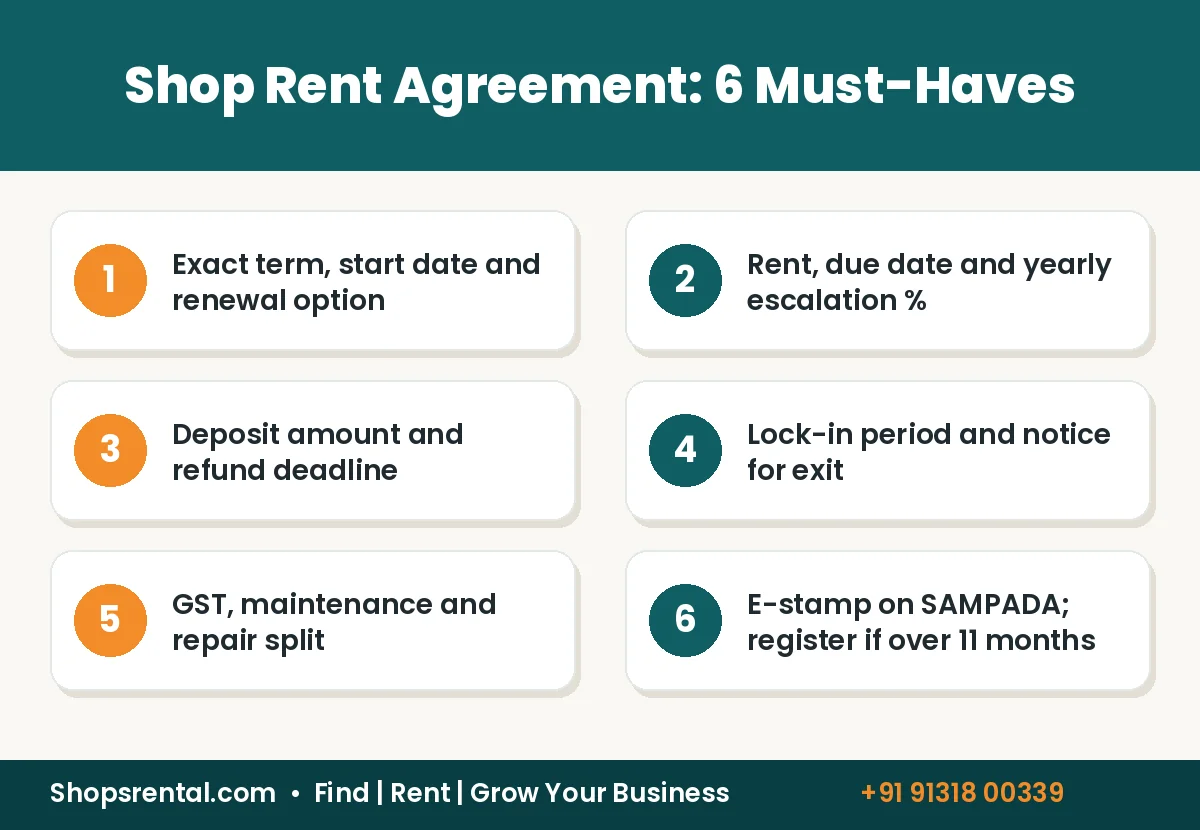
- Term and start date: exact start and end dates, renewal option and notice period for renewal.
- Rent and due date: monthly amount, due date (say by the 5th), mode of payment and late-payment interest.
- Security deposit: amount, whether interest-free, deductions allowed and refund timeline.
- Lock-in period: minimum period during which neither (or only one) party can terminate.
- Rent escalation: percentage increase and how often.
- GST and taxes: whether rent is inclusive or exclusive of GST; who pays property tax.
- Permitted use: the trade allowed (grocery, clinic, salon, restaurant) and a ban on illegal or hazardous use.
- Maintenance and utilities: society or market maintenance, electricity, water, minor and major repairs.
- Fit-outs and alterations: what the tenant may change and whether it must be removed at exit.
- Sub-letting and assignment: allowed or not, and on what conditions.
- Termination and notice: notice period, grounds for immediate termination and handover process.
- Default and dispute resolution: consequences of non-payment, jurisdiction (for example, Bhopal courts) and optional arbitration.
- Schedules and signatures: list of fixtures, photographs, signatures of both parties and two witnesses on every page.
Key commercial clauses explained
Lock-in period
A lock-in is the minimum period during which the tenant cannot vacate (and often the landlord cannot evict) except for a serious breach. For small shops, 6 to 12 months is common; for showrooms and restaurants where the tenant spends heavily on interiors, 2 to 3 years is normal. If you leave during the lock-in, the agreement usually makes you pay rent for the remaining lock-in months, so negotiate a lock-in that matches how quickly you can recover your setup cost.
Rent escalation
Most commercial leases in India carry an escalation of around 5 to 10 percent every 11 or 12 months, or 10 to 15 percent every three years on longer leases. These are market practices, not legal limits. Write the exact percentage and the date it applies so that there is no confusion at renewal.
Security deposit
For shops in Bhopal and other tier-2 cities, a deposit of about 3 to 6 months' rent is typical, though prime market frontage can demand more. The agreement should state that the deposit is interest-free (or not), list allowed deductions such as unpaid rent, electricity dues or damage beyond normal wear and tear, and fix a refund deadline, for example within 15 to 30 days of handover. Always take the deposit receipt and pay by bank transfer.
GST on commercial rent
Renting commercial property is a taxable service under GST at 18 percent. If the landlord is registered under GST, they charge GST on the rent invoice. A landlord generally needs registration once aggregate turnover crosses the threshold (Rs 20 lakh for services in most states, including MP). From 10 October 2024, if an unregistered landlord rents commercial property to a GST-registered tenant, the tenant pays GST under reverse charge; tenants under the composition scheme were later excluded from this from 16 January 2025. A registered tenant can usually claim input tax credit on this GST. Rules change often, so confirm the current position with your CA and state clearly in the lease whether rent is "plus GST".
Maintenance, repairs and utilities
Spell out who pays the market or building maintenance charge, the electricity bill (ideally from a separate sub-meter), water and property tax. A fair split is: tenant handles day-to-day and minor repairs; landlord handles structural repairs, roof leakage, major plumbing and the building's common areas.
Sub-letting and assignment
Many landlords ban sub-letting completely. If you plan to share space with another brand, take a franchise or sell the business later, ask for a clause allowing sub-letting or assignment with the landlord's written consent, which should not be unreasonably refused.
Termination and notice
After the lock-in, a notice period of one to three months on either side is standard. Also list grounds for immediate termination, such as non-payment for two or more months, illegal use or structural damage. Include a handover clause: keys returned, meter readings recorded and a joint inspection before the deposit is refunded.
11-month agreement vs registered lease: which should you choose?
Under Section 17 of the Registration Act, 1908, a lease of immovable property from year to year, or for any term exceeding one year, or reserving a yearly rent, must be compulsorily registered. Section 107 of the Transfer of Property Act says the same for leases above a year. An unregistered document that needed registration cannot be used as evidence of the lease terms in court, except for limited collateral purposes. This is why many landlords use 11-month agreements: they stay below the one-year limit and are renewed each year.
| Point | 11-month agreement | Registered lease (12 months or more) |
|---|---|---|
| Registration | Not compulsory (optional) | Compulsory under Section 17 |
| Stamp duty | Lower, often a small fixed amount | Calculated on rent and deposit |
| Security of tenure | Renewal each year at landlord's choice | Fixed term, lock-in enforceable |
| Evidence value | Valid if properly stamped | Strongest; public record |
| Best for | Kiosks, small shops, trial locations | Showrooms, restaurants, heavy fit-outs |
If you are investing lakhs in interiors, a registered lease of three to nine years with a clear lock-in usually gives better protection than repeated 11-month renewals.
Stamp duty on rent agreement in Madhya Pradesh
Every rent agreement must be stamped under the Indian Stamp Act as it applies in MP. An unstamped or under-stamped agreement is not admissible as evidence until the deficit duty and a penalty are paid. In Madhya Pradesh, stamp duty is paid as an e-stamp through the state's SAMPADA portal (now SAMPADA 2.0) or through a licensed service provider, not on old paper stamp sheets.
The stamp duty on rent agreement documents in MP depends on the lease period, the average annual rent and any premium or deposit. Commonly cited figures for 2025-26 are a small fixed duty for short agreements under one year and a percentage of the average annual rent plus deposit for longer leases, with higher rates for very long terms. Because rates and slabs are revised by the state and the published summaries differ, confirm the exact duty and registration fee on the SAMPADA portal or with the sub-registrar before you pay. Who bears the cost is a matter of agreement; in practice the tenant often pays, sometimes it is split equally.
Rent agreement registration process in MP
Rent agreement registration in Madhya Pradesh is done online through SAMPADA, followed by a visit to (or video verification with) the sub-registrar office. The usual steps are:
- Register as a citizen user on the SAMPADA portal and choose the lease deed category.
- Enter party details, property details, rent, deposit and term; the system calculates stamp duty and registration fee.
- Pay the duty and fee online to generate the e-stamp, and upload the draft deed.
- Book an appointment slot with the sub-registrar office for your area.
- Both parties and two witnesses appear with original ID proofs for photo, biometric verification and signatures.
- Download the registered, digitally signed deed once the sub-registrar approves it.
The procedure and options such as remote verification are updated from time to time, so check the current steps on the portal or with a document writer near your sub-registrar office.
Documents needed for a shop rent agreement in Madhya Pradesh
- Aadhaar card and PAN card of landlord and tenant (and of the authorised signatory for a firm or company).
- Passport-size photographs of both parties.
- Proof of ownership of the shop: registry, khasra/property tax receipt or latest electricity bill in the owner's name.
- For companies or LLPs: certificate of incorporation, board resolution or authority letter.
- Details and ID proofs of two witnesses.
- No-objection from the society or market association, if the building rules require it.
After signing, the tenant should also update the address on GST registration, Gumasta/shop and establishment licence, FSSAI licence (for food businesses) and the bank account, using the agreement as address proof.
Common mistakes to avoid
- Signing a downloaded format without changing the use clause to match your trade.
- Not mentioning whether rent is inclusive or exclusive of GST.
- Paying the deposit in cash with no receipt.
- Keeping a long lock-in on an unregistered 11-month agreement and assuming it will be enforceable.
- Skipping a joint inspection and photographs at the start, which later leads to deposit disputes.
- Forgetting police tenant verification where the local administration requires it.
Finding the right shop before you sign
The agreement only protects you if the shop itself suits your business. Browse verified shops for rent, compare areas such as MP Nagar and Kolar Road, and use our shop location checklist before you negotiate terms. Landlords can list a shop free and share their standard lease terms upfront, which saves time for everyone. For help with a specific property, reach us through the contact page.
Disclaimer: This article is general information as of 2026 and is not legal or tax advice. Laws, stamp duty rates and GST rules change; confirm the details with the sub-registrar, the SAMPADA portal, a qualified advocate or your chartered accountant.
Frequently Asked Questions
Is an online rent agreement valid for a shop?
Yes, an e-stamped agreement signed by both parties is valid. If the term is over 11 months, it must still be registered with the sub-registrar to be fully enforceable.
Can a landlord increase shop rent in the middle of the term?
Not unless the agreement allows it. Rent can be raised only as per the escalation clause or by mutual written consent.
Is notarisation enough instead of registration?
Notarisation only confirms the signatures. It does not replace compulsory registration for leases longer than one year.
Who keeps the original agreement?
Usually the tenant keeps the original and the landlord keeps a signed copy. For a registered deed, both can download a certified copy.
Can a shop be rented to a partnership firm or company?
Yes. The firm or company is named as tenant and an authorised partner or director signs, backed by an authority letter or board resolution.
Do I need a separate agreement for a kiosk or counter inside a mall?
Malls often use a leave and licence or conducting agreement instead of a lease. Read its exit, revenue-share and common area charge clauses carefully.
What happens if the landlord sells the shop during my lease?
A valid lease continues to bind the new owner. Ask the buyer to acknowledge your tenancy in writing to avoid confusion.
Is TDS deductible on shop rent?
Tenants who are liable to deduct TDS under the Income Tax Act must deduct it on rent above the prescribed limit. Check current thresholds with your CA.
Can I renew an 11-month agreement on the same stamp paper?
No. Each renewal is a fresh agreement and needs fresh stamp duty.
How long does registration take in Bhopal?
For a shop rent agreement in Madhya Pradesh, once the deed is filed on SAMPADA and the appointment is attended, registration is often completed the same day. Timelines can vary by office workload.

Founder of Shopsrental.com, Bhopal. Helps traders and brands find the right commercial space and helps owners rent faster.