
Knowing how to choose shop location well is the single decision that decides whether your shop struggles or grows. The best location for shop success is not always the busiest road; it is the right retail shop location for your customers. You can change your stock, staff and prices later, but once you sign a rent agreement and spend on interiors, you are tied to that spot. This guide gives you a practical shop location checklist of 15 points, a simple way to count footfall, and examples for six common business types, with Bhopal markets as reference.
Why the Right Retail Shop Location Matters
A good retail shop location brings customers to you for free. A weak one forces you to spend on discounts, delivery and advertising just to get people through the door. Most small shops in India depend on walk-in customers and repeat buyers from nearby colonies, so the street you choose is effectively your biggest marketing expense.
Before you start visiting properties, write down three things: who your customer is, what they buy, and how often. A grocery store needs daily neighbourhood buyers. A showroom needs people willing to travel. Your answers decide which points in the checklist below matter most.
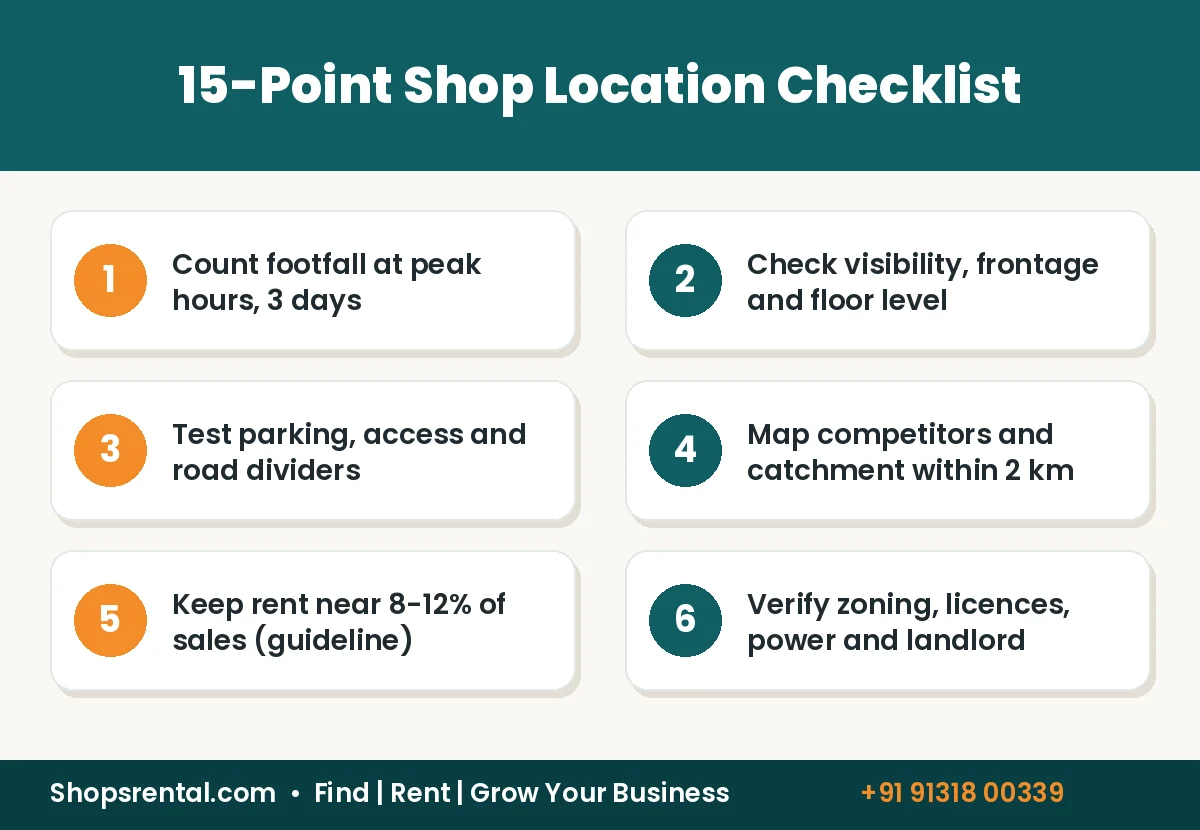
The 15-Point Shop Location Checklist
Use this list on every site visit. Give each point a score from 1 to 5 and compare shops side by side instead of going by gut feeling.
1. Count footfall yourself
Do not trust the broker's word. Stand near the shop with a phone counter app or a notebook and count people who walk past in 15-minute blocks. Do this on at least two weekdays and one weekend day, covering your peak hours: morning (8 to 11 am) for grocery and dairy, evening (6 to 9 pm) for clothing, cafes and mobile shops. Multiply each 15-minute count by four to get an hourly figure.
Count only relevant people. College students rushing to a bus are not buyers for a hardware store. Also note how many people actually stop and enter nearby shops. That tells you more than raw numbers.
2. Work out the footfall you need
There is no universal "good" number. Start from your break-even. Suppose you need 60 bills a day and you expect roughly 1 in 10 relevant passers-by to walk in, and half of them to buy. You would then need about 1,200 relevant passers-by daily. These figures are only an illustration; plug in your own margins and conversion estimates.
3. Visibility from the road
Can people see your shop from 50 metres away in both directions? Trees, electric poles, transformer boxes, staircases and parked trucks can hide a shop completely. A corner shop is usually more visible because it faces two roads, but it often costs more rent, so check whether the extra exposure is worth it for your trade.
4. Frontage and shop shape
A wide frontage works like a free display board. For most small retail shops, a frontage of 10 feet or more makes the counter and products clearly visible, though there is no fixed rule. A deep, narrow shop with a 6-foot front looks hidden even on a busy road. Measure frontage, depth and ceiling height, and check whether there is space for a shutter display.
5. Ground floor versus upper floor
For walk-in trades such as grocery, pharmacy and mobile accessories, a ground floor shop is almost always worth the higher rent. Upper floors suit appointment-based or destination businesses such as coaching, a clinic, or a bridal boutique where customers come with a plan.
6. Parking and access
In Bhopal, most customers arrive on two-wheelers. Check whether a scooter can stop for two minutes without blocking traffic. Look for road dividers that make your side hard to reach, one-way rules, and whether the shop is on the "going home" side of the road for evening buyers. Steps at the entrance can turn away elderly customers and parents with prams.
7. Competition nearby
Competition is not always bad. Clusters attract buyers: people go to a mobile market or a clothing lane because they can compare. For daily-need shops, though, a direct competitor right next door splits a limited neighbourhood demand. Walk 500 metres in each direction and list every similar shop, its price level and how busy it looks.
8. Catchment area
Your catchment area is the zone from where most of your customers will come. A grocery or pharmacy may draw from a 1 to 2 km radius. A furniture showroom may draw from across the city. Look at the colonies, apartments, offices, hostels, hospitals and schools within that radius, and the income level of the households. Ask: are these people likely to buy what I sell, at my price?
9. Rent-to-revenue ratio
A commonly used guideline is to keep monthly rent within about 8 to 12 per cent of expected monthly sales for most small retail shops. Low-margin trades like grocery need to stay at the lower end; higher-margin trades like salons or cafes can sometimes stretch. Treat this as a rule of thumb, not a law. If ₹30,000 rent needs ₹3 lakh of monthly sales to be comfortable, ask honestly whether this location can deliver that.
10. Zoning and trade licence
Confirm that the property is approved for commercial use. Shops in residential houses converted without permission can face sealing or penalties. Ask the landlord for the building permission or property tax record showing commercial use. In Bhopal you will typically need a trade licence from the Bhopal Municipal Corporation and registration under the MP Shops and Establishments Act, plus trade-specific licences such as FSSAI for food or a drug licence for a pharmacy. Rules and fees change, so verify with the municipal office or a consultant before signing.
11. Water, power and drainage
Check the sanctioned electricity load on the meter and compare it with your needs. A cafe with ovens, a salon with dryers and ACs, or a mobile repair counter will need more load than a clothing shop. Ask whether the meter is separate, who pays pending bills, and whether a load increase is allowed. For salons and cafes, a reliable water connection and drainage are essential.
12. Signage permission
Ask the landlord and the society or market association where you can put up a board, its size, and whether lit signboards are allowed. Large hoardings and projecting boards may need separate municipal permission. A great shop with no visible sign loses its location advantage.
13. Safety and building condition
Look for cracks, seepage, loose wiring and a working earthing point. Check for a fire exit or at least clear access, the condition of the shutter and locks, and whether the area floods in the monsoon. Visit after dark to see street lighting and whether the market feels safe for women customers.
14. The landlord and the terms
A good landlord is part of a good location. Ask about lock-in period, yearly rent increase, security deposit, maintenance charges, who handles repairs, and whether you can sublet or change the business. Get everything in a written agreement; see our guide on the shop rent agreement format in India. Talk to neighbouring shopkeepers about how the landlord behaves.
15. Future development
Upcoming flyovers, road widening, metro work or a new mall can help or hurt you. Construction can block a shop for months, while a finished metro station can lift an entire stretch. Ask local shopkeepers and check news about planned projects in the area. A developing area offers lower rent today but may take years to mature, so only choose it if you can survive the slow phase.
Best Location for Shop by Business Type
The best location for shop owners depends entirely on what you sell. Here is a quick guide, with Bhopal areas as examples. Treat these as starting points, not guarantees, and still run the full checklist.
| Business | What to look for | Bhopal examples |
|---|---|---|
| Grocery / kirana | Dense residential colonies, ground floor, easy two-wheeler stop, morning and evening traffic | Inner roads of Kolar Road, Indrapuri, Ayodhya Bypass colonies |
| Pharmacy | Near hospitals, clinics and large housing; visibility at night; space as per drug licence rules | Near hospitals on Hoshangabad Road, Kolar Road |
| Salon | Upper middle-class neighbourhood, parking, water supply, upper floor acceptable | Arera Colony, Kolar Road |
| Cafe | Colleges, offices, evening hangout streets, seating space, higher power load | MP Nagar, near colleges on Hoshangabad Road |
| Mobile shop | Busy market or mobile cluster, high footfall, strong signage | MP Nagar, New Market, Bairagarh |
| Clothing | Established shopping street, wide frontage, evening and weekend crowd | New Market, Bairagarh |
Grocery and pharmacy
Both are daily-need, low-ticket businesses. They win on convenience, so the shop should sit on the route people take home. A grocery store in a lane serving 500 to 1,000 households can do well even without a main road. For a pharmacy, being close to a hospital or a cluster of doctors' clinics matters most. Check the minimum area and pharmacist requirements for a drug licence with the MP Food and Drug Administration before renting.
Salon and cafe
These are experience businesses. Customers will travel a little for good service, so a first floor in a clean complex can work, provided parking is easy. Cafes depend on the evening crowd in areas like MP Nagar, and they need extra power, water and seating space, which suits a restaurant space listing more than a plain shop.
Mobile and clothing shops
These benefit from clusters. Buyers compare prices, so being inside a known market like New Market brings ready traffic, even with strong competition. Frontage and display matter a lot here, and evening and festival-season footfall is what pays the rent.
Main Road or Inner Market: Footfall vs Rent
A main road shop gets more visibility but usually higher rent, more dust and harder parking. An inner market or colony shop gets lower rent and loyal regulars. Choose a main road for destination and impulse trades; choose an inner road for daily-need trades where convenience beats visibility.
Common Mistakes When Choosing a Location
- Visiting only once, at an off-peak hour, and judging the whole market.
- Picking the cheapest rent without checking if anyone walks past.
- Ignoring the road divider that cuts off half the customers.
- Skipping zoning and licence checks, then facing sealing later.
- Not budgeting for the slow first few months.
Plan to spend at least one to two weeks evaluating a shortlist of three to five shops. That time is small compared with a lock-in of several years.
How to Choose Shop Location: Shortlist and Compare
Now that you know how to choose shop location step by step, browse verified shops for rent in Bhopal, filter by area, and use this checklist on each visit. If you own a shop, you can list it free and reach serious tenants. Need help? Contact us on WhatsApp.
Frequently Asked Questions
How do I choose a shop location as a beginner?
Start with your customer and product, then shortlist three to five shops and score each on footfall, visibility, parking, competition, rent and legal checks. Visit at peak hours more than once before deciding how to choose shop location for your trade.
How can I measure footfall without any tools?
Stand near the shop and count passers-by in 15-minute blocks using a notebook or a free counter app. Repeat on weekdays and a weekend, at your expected peak hours, and multiply by four to get an hourly estimate.
Is a corner shop always the best location for shop owners?
Not always. Corner shops get two-way visibility, but rent is often higher. They suit impulse and destination trades more than a small kirana in a quiet lane.
How much rent can my shop afford?
A common guideline is to keep rent within roughly 8 to 12 per cent of expected monthly sales. Low-margin trades should stay lower. Use it as a rule of thumb and test it with your own numbers.
Do I need a trade licence to open a shop in Bhopal?
Generally yes. Most shops need a municipal trade licence and Shops and Establishments registration, plus trade-specific licences such as FSSAI or a drug licence. Verify current rules locally as of 2026.
Is opening near competitors a bad idea?
It depends. For clothing and mobile phones, clusters attract buyers. For daily-need shops like grocery, a competitor next door can split limited demand.
Should I rent a shop in a new developing area?
Rent is lower, but customers take time to arrive. Choose it only if you have savings to cover a slower start and can see real housing occupancy nearby.
Which is better, ground floor or first floor?
Ground floor is better for walk-in trades. First floor can work for salons, clinics, coaching and boutiques where customers come with a plan.
What should I ask the landlord before renting?
Ask about lock-in, yearly increase, deposit, maintenance, repairs, power load, signage rights and commercial approval. Put all terms in a written agreement.
Is this shop location checklist useful outside Bhopal?
Yes. The 15 points apply to any Indian city; only the local examples and licence offices change.

Founder of Shopsrental.com, Bhopal. Helps traders and brands find the right commercial space and helps owners rent faster.